
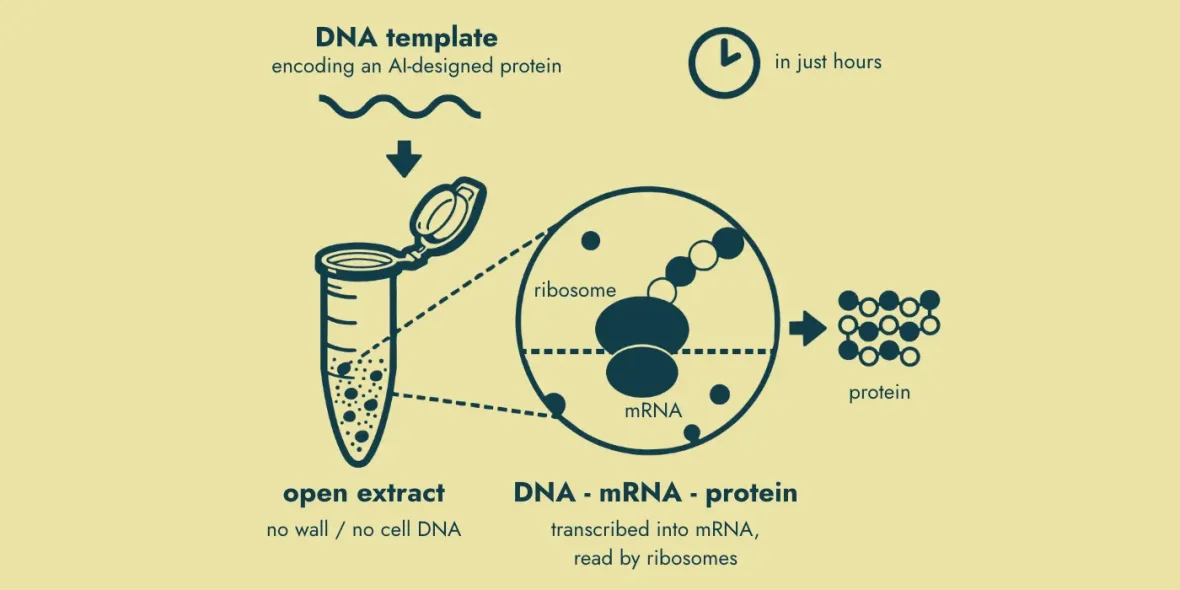
How do Cell-Free Systems work?
Unlike conventional methods that rely on living microorganisms, cell-free systems use molecular machinery extracted from cells, including ribosomes, enzymes and transfer RNA.
Researchers introduce the genetic instructions for a target protein into this cellular extract, along with the nutrients and energy sources needed for protein synthesis. The molecular machinery then uses these instructions to produce the corresponding protein in a controlled laboratory environment.
This approach allows researchers to adjust experimental conditions and test different protein sequences under comparable conditions.
Supporting protein engineering
Cell-free systems provide a flexible platform for evaluating protein candidates during early-stage research. Within SYNFEED, they help connect computational protein design with experimental production, supporting the identification of promising candidates for further development.
By integrating this technology into its research, SYNFEED is exploring new approaches to protein engineering for the future of animal nutrition.

Redefining proteins
Revolutionizing feeding
Copyright 2026 SYNFEED - All rights reserved · Privacy Policy · Cookies Policy

Funded by the European Union under Grant Agreement ID. 101186580. Views and opinions expressed are however those of the author(s) only and do not necessarily reflect those of the European Union or European Innovation Council and SMEs Executive Agency (EISMEA). Neither the European Union nor the granting authority can be held responsible for them.